
When venues evaluate a guest WiFi platform, messaging is rarely the first thing they consider. Portal design, analytics, GDPR compliance, vendor compatibility — these come first. Messaging feels like a detail.
It is not a detail. It is the delivery mechanism for every credential, every OTP, every verification email, every welcome-back message, and every campaign. If messaging isn’t working, none of the rest of it works for the guest.
And in most platforms, messaging is left entirely to the venue to figure out.
The typical approach — and its problems
Most guest WiFi platforms treat messaging as an integration task. The platform handles the WiFi logic; the venue connects their own email and SMS provider. Twilio for SMS. SendGrid or Mailchimp for email. Separate accounts, separate billing, separate configuration, separate rate limits to manage.
For a large operator with existing infrastructure this is manageable. For a hotel group deploying across 20 properties, a retailer with 50 locations, or an independent venue with no in-house technical resource, it creates real friction — vendor accounts to set up, API credentials to configure, deliverability to maintain, and carrier relationships to manage before a single OTP can be sent.
And then there are the coverage gaps. SMS delivery across different geographies involves different carriers, different regulations, and different sender ID requirements. A Twilio account configured for the UK may not deliver cleanly to a guest arriving from South Korea.
Wiacom default channels
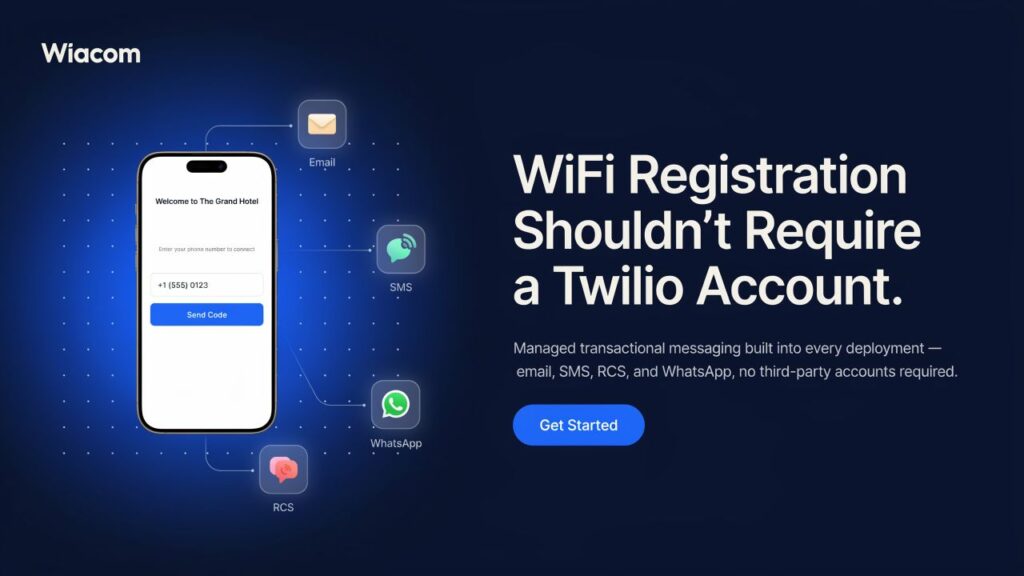
Wiacom provides managed transactional messaging as a built-in platform capability — no third-party accounts required.
Email is available by default across all deployments, covering registration confirmation, email address verification, WiFi credential delivery, guest self-service privacy page links, and re-engagement campaigns. Sender configuration — name, reply-to address, and domain alignment — is handled per deployment.
SMS covers the full registration messaging flow: OTP and PIN delivery for phone-based sign-up, credential delivery, and campaign communications. Global coverage across major markets, with regional carrier relationships managed on the Wiacom side.
RCS (Rich Communication Services) is supported for compatible devices and networks — enabling richer message formatting, branded sender identity, and read receipts where the recipient’s carrier supports it.
WhatsApp is supported for deployments where WhatsApp Business messaging is the preferred or expected channel for guest communication — increasingly relevant in markets where WhatsApp is the primary communication platform.
Why it matters operationally
The practical advantage of Wiacom default channels is that delivery works from day one, without prerequisites. A new location goes live and phone registration works immediately — no Twilio account, no API keys, no carrier configuration to sort out first.
For operators running multiple locations across different markets, default channels also mean consistent delivery behaviour and a single point of accountability — Wiacom manages the delivery infrastructure, not a stack of individually managed third-party accounts.
Bring your own if you prefer
Default channels are not mandatory. Venues with existing SMS or email infrastructure — their own Twilio account, a preferred ESP, an internal mail server — can connect their own delivery services instead. Wiacom already has integrations in place for the most widely used providers.
The choice is the point. Wiacom default channels mean messaging works immediately, out of the box, with no external dependencies. Customer-provided services are there when an operator has existing infrastructure they want to use.
Wiacom includes managed email, SMS, RCS, and WhatsApp delivery as default platform channels — available across all deployments with no third-party account required. Customer-provided delivery services are also supported.
