
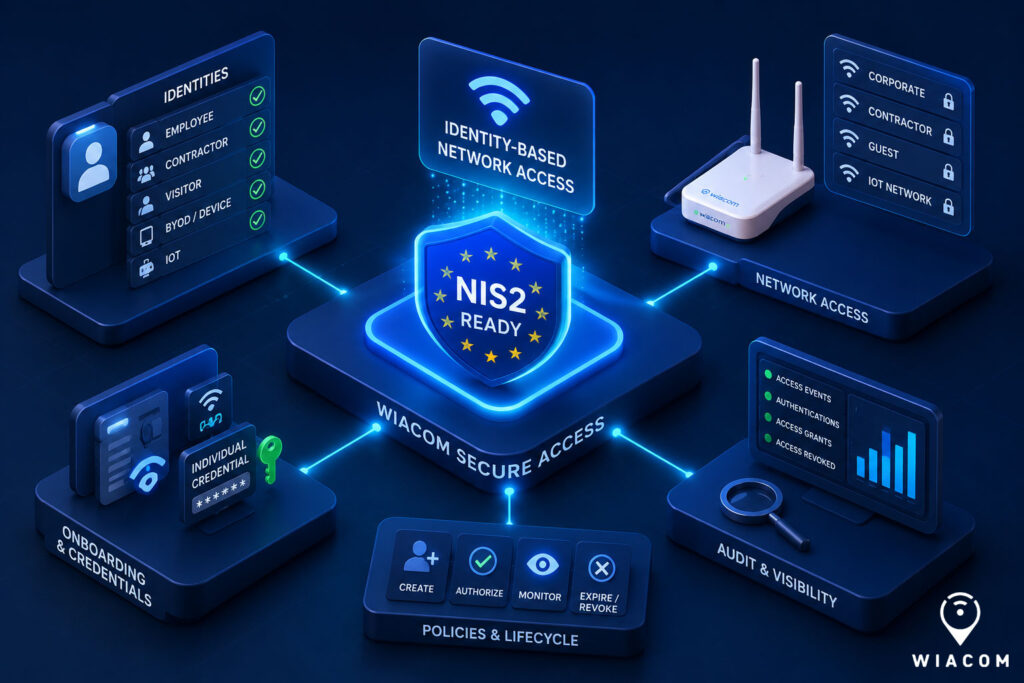
NIS2 puts stronger emphasis on access control, authentication, accountability and operational security.
For organisations operating multiple sites, the challenge is often not defining the policy. It is applying it consistently across the network, especially when the infrastructure is mixed.
Cisco at headquarters. Aruba in warehouses. UniFi at smaller branches. Different controllers, different authentication methods and different troubleshooting tools.
Wiacom can provide a common identity and network-access layer above that infrastructure.
Where supported, Wiacom can also be integrated with ISP-provided CPE using custom firmware or embedded software components, allowing service providers to extend Wiacom onboarding, identity, access control and operational visibility directly into the equipment already deployed at customer locations.
This creates another path for telcos and ISPs:
existing CPE → Wiacom-enabled firmware → identity-based access → central management and troubleshooting
without requiring the customer to replace the installed access equipment.
One access layer across different Wi-Fi vendors
Wiacom is vendor agnostic.
Organisations and managed service providers can use a common approach to onboarding, identity and network access while continuing to operate the wireless infrastructure already deployed.
Depending on the environment, Wiacom can support access through:
- individual iPSK / MPSK-style credentials;
- Passpoint profiles;
- RADIUS-based authentication;
- identity-based onboarding;
- temporary or expiring credentials;
- captive portal access where required.
The objective is simple:
Identity → individual access → controlled lifecycle → audit visibility
without requiring every location to use the same Wi-Fi vendor.
Replace shared credentials with identifiable access
Shared Wi-Fi passwords make individual access difficult to control even with rotation mechanism in place.
Wiacom can associate access with a specific user, contractor or device instead.
An individual credential can be created, restricted, expired or revoked without changing access for everyone else.
This is particularly useful for:
- employees
- contractors
- suppliers
- BYOD
- temporary personnel
- operational devices
- IoT
For third-party access, the lifecycle can be straightforward:
Contractor created → individual access issued → authorised network access → credential expires → access revoked
ENISA’s NIS2 technical implementation guidance specifically addresses access control, authentication, logging and evidence around authorised access.
Built for MSP operations
NIS2 is also directly relevant to managed service providers and managed security service providers covered by the EU implementing requirements.
For an MSP managing many customers, standardising every customer’s network infrastructure is rarely realistic.
Wiacom provides another option.
Customer A → Cisco Meraki
Customer B → Aruba
Customer C → UniFi
Customer D → mixed environment
The underlying Wi-Fi can remain different while Wiacom provides a common layer for identity, onboarding, access policies and operational visibility.
This allows an MSP to build a more consistent managed-access service without becoming dependent on a single wireless vendor.
Advanced troubleshooting at user level
Security and support increasingly overlap.
Wiacom can bring together the user journey and network authentication events to provide deeper troubleshooting visibility.
Identity → onboarding → credential → device → authentication → access decision → network
Support teams can investigate:
- failed authentication;
- expired credentials;
- incorrect access assignments;
- device-specific problems;
- repeated connection failures;
- onboarding issues;
- access attempts after expiry;
- inconsistencies between sites.
For MSPs, this provides advanced troubleshooting above the underlying Wi-Fi vendor rather than requiring a separate operational process for every platform.
From one site to geographically distributed networks
NIS2-related network controls become harder to maintain as organisations expand.
A customer may operate:
10 branches in one country
100 locations across Europe
multiple subsidiaries
different MSPs
different Wi-Fi generations and vendors.
Wiacom is designed as a centrally managed SaaS layer, allowing identity and access workflows to be applied across geographically distributed environments.
Policies and onboarding processes can therefore remain consistent even when the infrastructure below them is not.
One organisation. Multiple countries. Multiple Wi-Fi vendors. One access layer.
Access should have a lifecycle
Network access should not remain active simply because a password is still known.
With Wiacom, access can follow a defined lifecycle:
Create → Authorise → Connect → Monitor → Expire or Revoke
The same model can be applied to users, contractors and devices.
This also creates clearer operational evidence when organisations need to understand who was authorised to access a network and when that access changed.
Operational visibility supports better evidence
ENISA’s implementation guidance includes logging, access records, authentication activity and audit trails among the mechanisms organisations can use to support cybersecurity controls and investigations.
Wiacom can help expose the network-access context behind those events:
who connected
which device was used
where the connection occurred
how the identity was onboarded
which access method was issued
whether authentication succeeded
when the credential expired or was revoked
This information can also be integrated into broader operational or security workflows.
Wiacom can also integrate with external SIEM, SOC and security automation platforms through APIs or custom integrations, allowing network-access events to become part of the organisation’s wider detection and response workflows.
Where required, Wiacom can also provide its own response and automation layer.
Authentication failures, expired credentials, unusual access patterns, repeated connection attempts or policy violations can be evaluated by Wiacom and used to trigger automated actions, alerts or remediation workflows.
This creates a broader operational model:
Access event → detect → correlate → respond → automate
For MSPs and distributed organisations, Wiacom can therefore operate either as a source of network-access intelligence for an existing SIEM/SOC stack, or as an active automation layer for access-related response.
NIS2 without replacing the network
Wiacom does not replace the broader NIS2 compliance programme.
It addresses a specific operational area:
identity-based network access, credential lifecycle, third-party access, authentication visibility and troubleshooting across distributed Wi-Fi environments.
For organisations and MSPs operating mixed wireless infrastructure, that can be particularly useful.
The network underneath may remain Cisco, Aruba, UniFi or another supported platform.
The access layer above it can become consistent.
Vendor agnostic.
Identity based.
Individually revocable.
Auditable.
Geographically scalable.
Built for MSP operations.
That is where Wiacom can support a stronger NIS2 network-access strategy.
One access layer. Mixed vendors. Multiple locations. Central control.
Wiacom is ISO/IEC 27001 certified, designed and operated in the EU, with hosting available globally, including EU-hosted environments for customers with NIS2-related data residency and compliance requirements, and customer-network deployments where required. For MSPs, telcos and distributed organisations, this adds another layer of assurance when Wiacom becomes part of the network identity, access and operational stack.
