
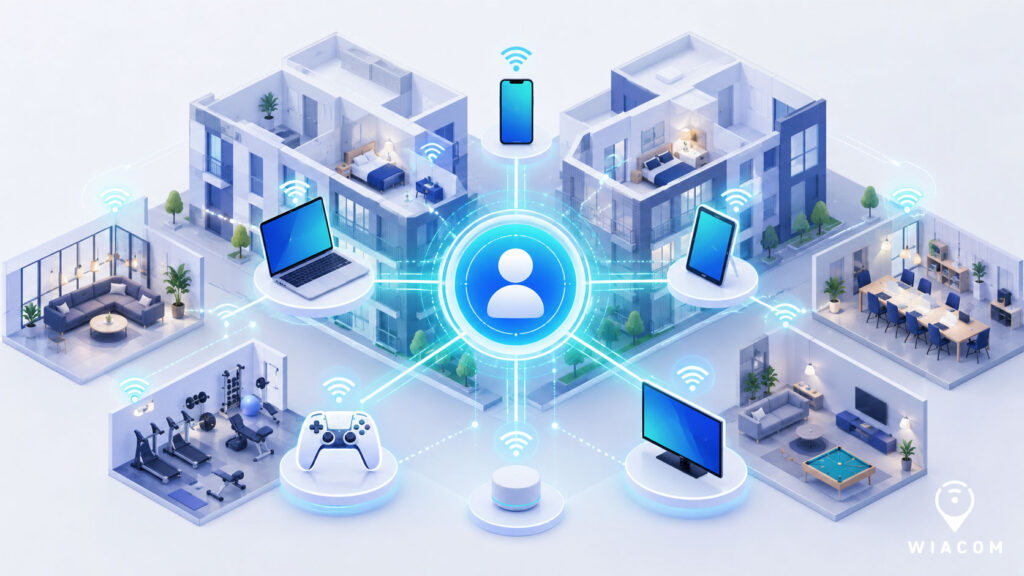
Resident WiFi in managed living should follow the resident, not a shared password. For student accommodation, Build-to-Rent, co-living and other managed living operators, Wiacom links each resident’s tenancy, booking or profile to personal WiFi access across all their devices, on the WiFi infrastructure already installed.
Student accommodation, Build-to-Rent, co-living and other managed living environments are becoming increasingly digital.
Residents may already have a tenancy agreement, booking, resident account or profile before they arrive.
But WiFi access is still often handled separately — through shared passwords, manual registration or credentials that are difficult to manage when residents move in and out.
Wiacom can connect the resident lifecycle with the WiFi network.
Replace shared passwords with personal resident WiFi (iPSK, MPSK, PPSK)
Instead of giving every resident the same WiFi password, Wiacom can provide individual network access linked to the resident.
Depending on the network environment, this can include:
- individual iPSK / MPSK / PPSK credentials issued through Guest Connect;
- Passpoint profiles for automatic, secure reconnection;
- RADIUS-based access, including WPA2/WPA3 Enterprise;
- Wiacom Horizon personal WiFi, depending on the property and stay type;
- captive portal access where required.
Each resident can have their own access without changing credentials for everyone else.
Guest Connect lets residents register or be invited before they arrive, including offsite, through a link or QR code in tenancy or move-in communications, and receive either a unique PSK or a Passpoint profile for their own devices.
One resident can have multiple devices
A resident may need to connect:
phone → laptop → tablet → Smart TV → gaming console → other personal devices
Wiacom can associate those devices with the same resident identity.
This provides a more residential experience while allowing the operator or managed service provider to keep access centrally controlled.
Resident WiFi that follows the tenancy lifecycle
WiFi access can also follow the same lifecycle as the tenancy, booking or membership.
For example:
Resident created → WiFi access prepared → resident moves in → devices connect → tenancy ends → access expires
The resident management platform remains the source of resident information, while Wiacom manages the network onboarding and access layer.
Extend the same identity across the property
Personal WiFi access does not need to stop at the apartment or room.
The same resident identity can be used across authorised areas such as:
- apartments or rooms;
- lounges;
- study spaces;
- gyms;
- coworking areas;
- other shared facilities.
For multi-property operators, the same concept can also support access across several locations.
Resident WiFi for PBSA, Build-to-Rent, co-living and more
The same model can apply to:
Purpose-Built Student Accommodation (PBSA)
Personal WiFi access for students and their devices, automatically linked to the tenancy period.
Build-to-Rent
Resident-centric connectivity across apartments and shared amenities.
Co-living and flex-living
Network access that follows stays lasting weeks, months or years.
Serviced apartments
WiFi onboarding prepared before arrival as part of the digital guest journey.
Senior living
Simplified personal connectivity for residents and their devices while maintaining controlled network access.
For WiFi across university campuses and teaching buildings, see Wiacom Education & Campus WiFi.
An identity layer above the existing WiFi network
Wiacom does not need to replace or standardise the wireless infrastructure. It can connect existing resident, booking or property systems with the access methods supported by the network.
Resident system / PMS / booking / API → Wiacom → personal WiFi identity → network access
This allows operators and managed service providers to maintain a consistent resident onboarding experience across different properties and wireless environments.
Built for MSPs and mixed-vendor environments
Wiacom is designed for managed service providers operating across multiple customers, sites and WiFi platforms.
It can provide a consistent identity, onboarding and access layer across mixed-vendor environments, helping avoid a different user journey for every wireless platform.
For MSP operations, Wiacom also adds advanced troubleshooting and user-level visibility, making it easier to investigate onboarding, authentication and access issues across multiple locations from a common platform. Wiacom also provides managed WiFi services and technical operations alongside operators and MSP teams.
Implementation and support for resident WiFi
Wiacom is not only a software licence. We can configure controllers, SSIDs, VLANs and access policies, integrate RADIUS, Passpoint and individual credentials, connect resident, booking and property systems through APIs, and troubleshoot onboarding and authentication across mixed-vendor properties. We work alongside the operator’s IT team or MSP and support multi-property rollouts. See Wiacom technical support and professional services.
From managed WiFi to managed identity
In managed living environments, connectivity is no longer only about providing an SSID and password.
The resident is already known.
The opportunity is to make that identity useful to the network as well.
One resident. One WiFi identity. Every device.
Resident WiFi: frequently asked questions
What is resident WiFi?
It is personal network access for people living in managed accommodation such as student housing, Build-to-Rent, co-living and serviced apartments, linked to the resident’s tenancy or booking instead of a shared password.
How can residents get personal WiFi without a shared password?
Each resident receives individual credentials, such as a unique PSK (iPSK / MPSK / PPSK) or a Passpoint profile, so access can be created, restricted, expired or revoked without affecting anyone else. With Guest Connect, residents can onboard before they arrive.
Can one resident connect multiple devices?
Yes. Wiacom can associate a resident’s phone, laptop, tablet, Smart TV, gaming console and other personal devices with the same resident identity, while the operator keeps access centrally controlled.
What happens when a tenancy ends?
Access can follow the tenancy lifecycle. When the tenancy or booking ends, the resident’s WiFi access expires automatically, depending on the integration with the resident or booking system.
Does the WiFi network need to be replaced?
No. Wiacom is vendor agnostic and operates above compatible WiFi infrastructure, including Cisco Meraki, Cisco WLC, HPE Aruba, Ruckus, UniFi, Cambium and Fortinet.
Can MSPs use it across different operators and properties?
Yes. Wiacom provides a consistent identity, onboarding and access layer across customers, sites and WiFi platforms, with user-level troubleshooting from a common platform.
Wiacom provides identity-based WiFi onboarding, individual network credentials, Passpoint Connect, Horizon personal WiFi, captive portal access, API integrations and multi-property management for managed living environments.
See more about Wiacom Access Features→ · Guest Connect → · Request a demo →


