
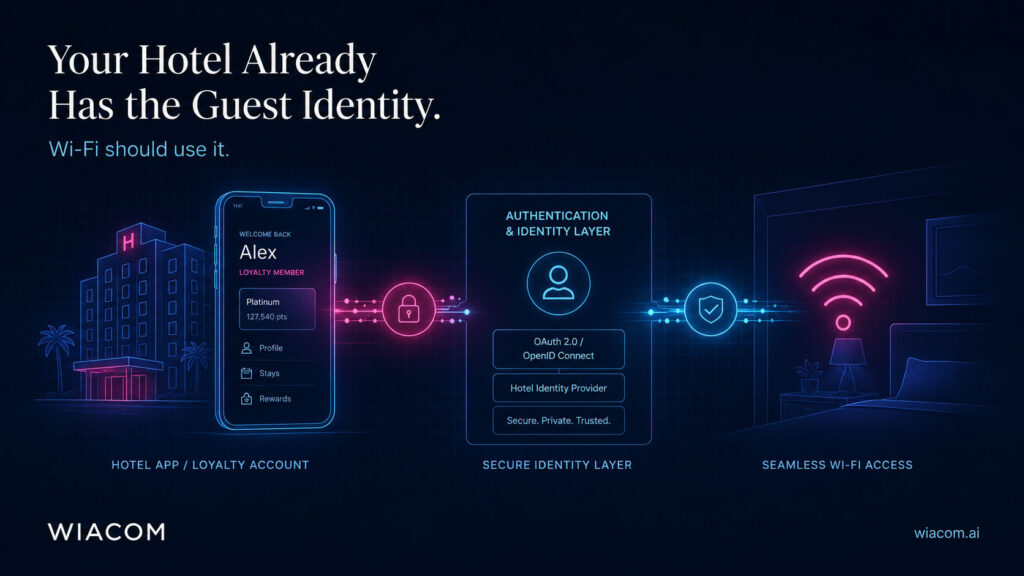
A hotel WiFi solution should not make known guests register again. Wiacom connects guest WiFi with the PMS, loyalty programme, hotel app and existing guest identity systems, so onboarding can start before arrival and returning guests can reconnect with fewer steps, on the WiFi infrastructure the hotel already has.
Hotels already know many of their guests before they arrive.
They may have booked directly, through an OTA, joined the loyalty programme, used the hotel app, completed digital check-in, or already have a reservation in the property management system.
But when they connect to WiFi, they are often asked to start again — enter an email address, confirm it, accept terms, and register separately.
It does not have to work that way.
Many hotel groups already use a central guest identity platform behind their website, mobile app or loyalty programme — such as Okta, Microsoft Entra ID, Auth0, Ping Identity or another similar provider. Wiacom can connect to that existing identity journey, so recognised guests can use the account they already have instead of registering again just for WiFi.
WiFi onboarding does not need to start at the captive portal
Guest WiFi is often treated as something that begins only after the guest arrives, selects the hotel network, and sees a captive portal.
With Wiacom, onboarding and WiFi access are separate.
A guest can be onboarded through different channels, including:
- the captive portal;
- a pre-arrival link or QR code through Guest Connect;
- the hotel app or loyalty programme;
- the PMS or booking workflow;
- an external application or API.
This means onboarding can happen before the guest reaches the property — during booking, digital check-in, a pre-arrival email, or another existing hotel journey.
Let loyalty members sign in to hotel WiFi with the account they already have
Wiacom can connect the WiFi journey with the systems the hotel already uses.
For example, an existing loyalty member could simply choose:
Sign in with your hotel account
If the guest is already known and verified by the hotel, there is no need to ask them to verify the same email address again.
The hotel keeps its existing guest account and loyalty systems, while Wiacom uses that trusted identity to provide the appropriate WiFi experience.
Direct bookings, loyalty members and OTA guests can follow different journeys
Not every guest arrives through the same channel. A direct-booking guest may already have a hotel account.
A loyalty member may already be recognised through the hotel app.
An OTA guest may exist in the PMS but have no direct relationship with the hotel yet.
For an OTA guest, WiFi can even become an opportunity to create a direct, consented relationship with the hotel — without changing the original booking channel.
The objective is to use the information already available and only ask for what is actually missing.
Pre-arrival WiFi onboarding: start before the guest arrives
WiFi onboarding can also begin before check-in.
With Wiacom Guest Connect, hotels can include a registration link or QR code in:
- pre-arrival emails;
- booking confirmations;
- the hotel app;
- digital check-in;
- loyalty communications;
- other guest communications.
The guest can complete the required steps before reaching the property.
Instead of:
Arrive → find WiFi → register → verify → connect
the experience can become:
Book → prepare access → arrive → connect
Hotel WiFi PMS integration
Wiacom can also integrate with the hotel’s property management system, including Oracle OPERA Cloud, and can connect to other PMS platforms through APIs and custom integrations.
This allows the WiFi journey to use information already connected to the guest’s stay.
Depending on the hotel workflow, this can help with:
- confirming that the guest has a valid reservation;
- preparing access before arrival;
- linking WiFi access to the stay;
- automatically ending access after departure;
- recognising returning guests;
- avoiding repeated registration;
- supporting different journeys for direct and OTA guests.
The PMS remains the source of stay information, while Wiacom manages the WiFi onboarding experience around it.
Choose the right access experience for each guest
Once onboarding is complete, Wiacom can provide the access method that best fits the property and the guest journey.
A first-time visitor may receive immediate access through the captive portal. A guest registered before arrival may receive an individual WiFi Pass (unique credential iPSK/DPSK/MPSK). A returning guest can use Passpoint Connect for automatic reconnection, while Wiacom Horizon can provide a personal WiFi network for the duration of the stay.
These methods can coexist at the same property.
The result is that hotels are no longer forced to design every guest journey around a single splash page or shared WiFi password.
After the initial onboarding, supported access methods can allow the guest’s device to recognise and securely reconnect to the hotel’s WiFi on future stays, while Wiacom remains synchronised with the hotel PMS for reservation status, stay dates, access validity and guest profile context.
Read more about Passpoint WiFi and Hotspot 2.0 for hotels.
That means a returning guest may no longer need to:
select the network → open a portal → enter details → reconnect
Instead, the experience can become much closer to:
Arrive → automatically connect
Turn WiFi into part of the guest journey
WiFi should not be an isolated technical service that starts when a guest asks reception for the password.
It can become part of the wider hotel journey:
Booking → pre-arrival → check-in → WiFi access → stay → engagement → return visit
By connecting WiFi with the PMS, loyalty programme, hotel application, guest identity systems and CRM/CDP, hotels can reduce unnecessary steps, improve guest recognition and build consented first-party guest data.
Fewer steps for guests, better recognition for hotels
The guest should not need to understand how the technology works.
They should simply have fewer steps.
For the hotel, the benefit is also straightforward: existing guest systems, loyalty programmes, reservations and WiFi can work together instead of creating separate guest identities.
The result is a smoother arrival experience, better guest recognition and a more connected digital journey throughout the stay.
Implementation and support for hotel WiFi
Wiacom is not only a software licence. We can configure controllers, SSIDs, VLANs and access policies, integrate RADIUS, Passpoint and individual credentials, connect the PMS, hotel app, loyalty and CRM/CDP systems through APIs, and troubleshoot guest connectivity across mixed-vendor properties. We work alongside the hotel’s IT team or MSP and support multi-property rollouts. See Wiacom technical support and professional services.
Hotel WiFi, PMS and loyalty: frequently asked questions
What is hotel WiFi PMS integration?
It connects the guest WiFi journey to reservation data in the property management system, so access can be prepared before arrival, linked to the stay and ended after departure, and returning guests can be recognised.
Can hotel guests log in to WiFi with their loyalty account?
Yes. Where the hotel already uses an identity platform such as Okta, Microsoft Entra ID, Auth0 or Ping Identity for its app or loyalty programme, Wiacom can connect to that journey so recognised guests can use the account they already have.
Can guests be onboarded to WiFi before they arrive?
Yes. With Guest Connect, a registration link or QR code can be included in pre-arrival emails, booking confirmations, the hotel app or digital check-in, so guests can complete the steps before reaching the property.
How can returning guests connect automatically?
After initial onboarding, supported access methods such as Passpoint Connect or an individual WiFi Pass can let the guest’s device reconnect securely on future stays, while Wiacom stays synchronised with the PMS for reservation status and access validity.
Does the hotel need to replace its WiFi infrastructure?
No. Wiacom is vendor agnostic and operates above compatible WiFi infrastructure, including Cisco Meraki, Cisco WLC, HPE Aruba, Ruckus, UniFi, Cambium and Fortinet.
Does Wiacom replace the PMS or the loyalty programme?
No. The PMS remains the source of stay information and the hotel keeps its loyalty and guest-account systems. Wiacom connects WiFi to them instead of creating a separate guest identity.
Wiacom connects guest WiFi with PMS platforms, hotel and loyalty applications, OTA and direct-booking journeys, pre-arrival onboarding, personal iPSK/MPSK access, Passpoint Connect, captive portals, CRM/CDP platforms and existing guest identity systems.
See more about Wiacom Access Features→ · Guest Connect → · Request a demo →


