
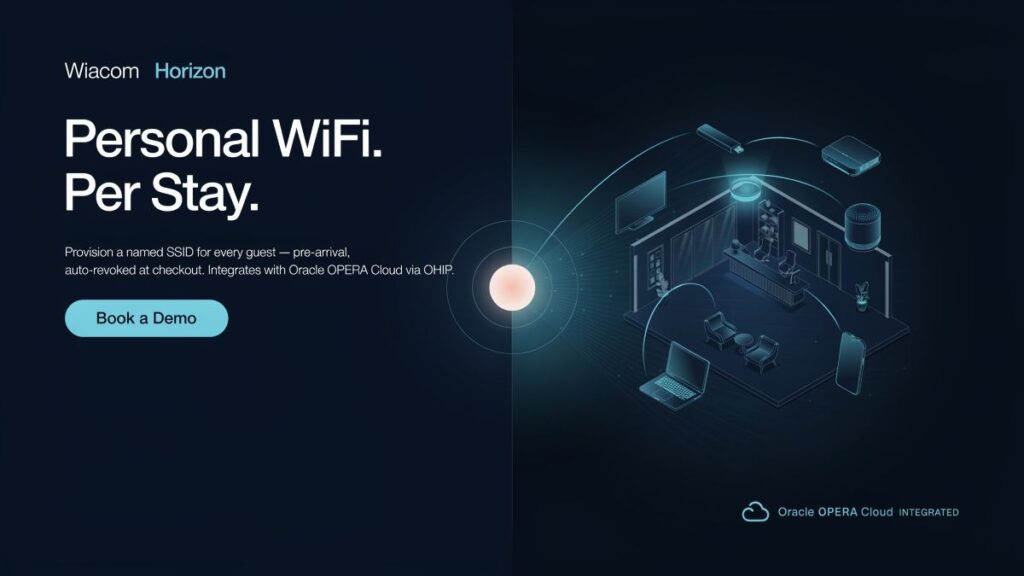
Personal WiFi for hotel guests means each guest has their own named network, not just their own password on a shared SSID. Wiacom Horizon, part of Wiacom’s hotel WiFi solution, provisions a dedicated personal network per stay on the WiFi infrastructure the hotel already has, activated at check-in and removed at check-out. The same approach works for short-term rentals and serviced apartments.
Most hotel WiFi upgrades today stop at the same point: give each guest a unique password on a shared network. It is a genuine improvement over a single password for everyone. But it is not personal WiFi. And guests increasingly know the difference.
The problem with shared SSIDs
When every guest connects to the same SSID — “HotelGuest”, “StayConnected”, or whatever the property calls it — they are all on a shared network. Each has their own passphrase, but the fundamental experience is shared.
The friction surfaces in predictable ways. Smart TVs, streaming sticks, gaming consoles, and smart speakers don’t auto-connect — they lack browsers for captive portals and don’t recognise a passphrase they’ve never seen. Guests spend time at check-in entering a long random password across six devices. If they move between the room and the lobby, the session can drop. If they return for a second stay, they start over.
These are the WiFi complaints that appear in reviews. They are also entirely avoidable.
What a personal network actually means
Personal WiFi means each guest has their own named SSID — a network that can look, to every device they carry, like their WiFi at home.
The guest chooses the network name and password, typically the same as at home. Their phone, laptop, tablet, wearables and streaming devices already know that network, so everything can join automatically, without prompts and without captive portal friction.
This is what Wiacom Horizon delivers. Not a unique passphrase on a shared SSID — a dedicated named network per guest, provisioned on the hotel’s existing WiFi infrastructure, activated at check-in and removed at check-out.
How it works
When a guest checks in — or before they arrive if pre-arrival provisioning is enabled — Horizon creates a real SSID slot on the hotel’s WiFi controller assigned to that guest.
At check-out, the SSID is revoked automatically and the slot returns to the pool. No staff action required. No credential to manage.
Horizon works on the infrastructure the hotel already has, including Cisco Meraki, HPE Aruba (cloud), Ruckus and MikroTik. Where the platform can reach the controller, it provisions through the vendor’s API. Where it cannot, the Wiacom Agent — a managed local appliance deployed inside the customer-controlled network, with no inbound connectivity required — handles provisioning on-premises. No hardware change required.
With PMS integration, the guest’s dates come from the reservation: access can be prepared before arrival and ended automatically after departure. Wiacom integrates with Oracle OPERA Cloud and can connect to other PMS platforms through APIs and custom integrations.
Not just hotels: short-term rentals and serviced apartments
Personal WiFi per stay is not limited to hotels. Operators of short-term rentals — apartments and homes listed on platforms such as Airbnb — serviced apartments and aparthotels face the same problem: a shared password, left on a card or in a welcome message, that every guest uses and that is rarely changed between stays.
Horizon can give each guest their own named network for the stay, provisioned on the property’s supported WiFi infrastructure and removed at check-out, with dates taken from the booking or property management system where it is integrated. The guest keeps the same familiar network name and password for every device, and the host or operator does not have to change credentials between stays.
For longer stays, see Wiacom’s approach to resident WiFi in managed living environments.
Personal WiFi, Passpoint or individual credentials?
Horizon is one of several access methods Wiacom can provide at the same property. A WiFi Pass gives a guest an individual credential on the hotel’s network; Passpoint Connect lets returning guests reconnect automatically; the captive portal handles first-time visitors; and Guest Connect lets guests register before they arrive. Horizon is for guests who want their own named network for the stay. See how they work together in Your Hotel Already Knows the Guest. WiFi Should Too.
Access control and compliance
Individual, time-limited credentials help hotels manage who is on the network and for how long.
A personal network per guest, tied to the reservation and revoked automatically at check-out through PMS integration, supports the credential-lifecycle and access-control practices that frameworks such as PCI DSS v4.x and GDPR Article 32 point to, where they apply to the hotel’s network.
It does not replace a hotel’s own compliance programme or assessment.
The guest experience argument
Hotels compete on experience. WiFi is increasingly part of that experience — not as a background utility but as something guests notice. A guest who connects at check-in, watches every device join automatically, and finds their usual network name and password working again on their next stay is having a qualitatively different experience from one entering a 20-character passphrase across multiple devices every time they return to their room.
Personal WiFi per stay. A small operational decision with a disproportionate effect on how connected — and how cared for — the stay feels.
Implementation and support for personal hotel WiFi
Wiacom is not only a software licence. We can configure the controller, SSID pool and access policies, deploy the Wiacom Agent where needed, connect the PMS, and troubleshoot guest connectivity across mixed-vendor properties, working alongside the hotel’s IT team or MSP. See Wiacom technical support and professional services.
Personal WiFi for hotel guests: frequently asked questions
What is personal WiFi for hotel guests?
Each guest has their own named WiFi network for the stay, instead of a unique password on a shared SSID. Wiacom Horizon provisions it on the hotel’s existing WiFi infrastructure at check-in and removes it at check-out.
How is it different from a unique password on a shared network?
A unique passphrase still puts every guest on the same SSID. A personal network gives each guest their own named SSID, so devices that already know the guest’s chosen network name and password can join without prompts or a captive portal.
Does the hotel need new hardware?
No. Horizon runs on the hotel’s existing WiFi infrastructure, including Cisco Meraki, HPE Aruba (cloud), Ruckus and MikroTik. Where the controller cannot be reached from the cloud, the Wiacom Agent, a managed local appliance, handles provisioning.
Can Horizon be used for short-term rentals?
Yes. Horizon is not limited to hotels. Short-term rental operators and serviced apartment providers can give each guest a personal named network for the stay on supported WiFi infrastructure, with access ended automatically at check-out.
How many guests can have a personal network at the same time?
Personal networks use SSID slots from a managed pool on the controller, so the number of concurrent personal networks depends on the controller’s SSID capacity and how the pool is configured. Wiacom sizes this with the property and can combine Horizon with Passpoint or WiFi Pass for other guests.
What happens at check-out?
The personal SSID is revoked automatically and its slot returns to the pool. With PMS integration, dates come from the reservation, so no staff action is needed.
Can personal WiFi be prepared before arrival?
Yes, where pre-arrival provisioning is enabled. The network is scheduled from the arrival date and activated when the stay begins.
Wiacom Horizon provisions personal named SSIDs per guest on supported WiFi infrastructure in hotels, serviced apartments and short-term rentals, including Cisco Meraki, HPE Aruba (cloud), Ruckus and MikroTik. Integrates with Oracle OPERA Cloud via OHIP, with pre-arrival provisioning and automatic check-out revocation.
Learn more about Horizon → · Hotel WiFi solutions → · Request a demo →


