
Cambium customers and partners are currently reviewing how to maintain access, onboarding and customer-facing services as the cnMaestro environment changes.
For organisations using EasyPass, ePSK/UPSK, captive portals, RADIUS, analytics or customer integrations, the question is broader than where the access points will be managed.
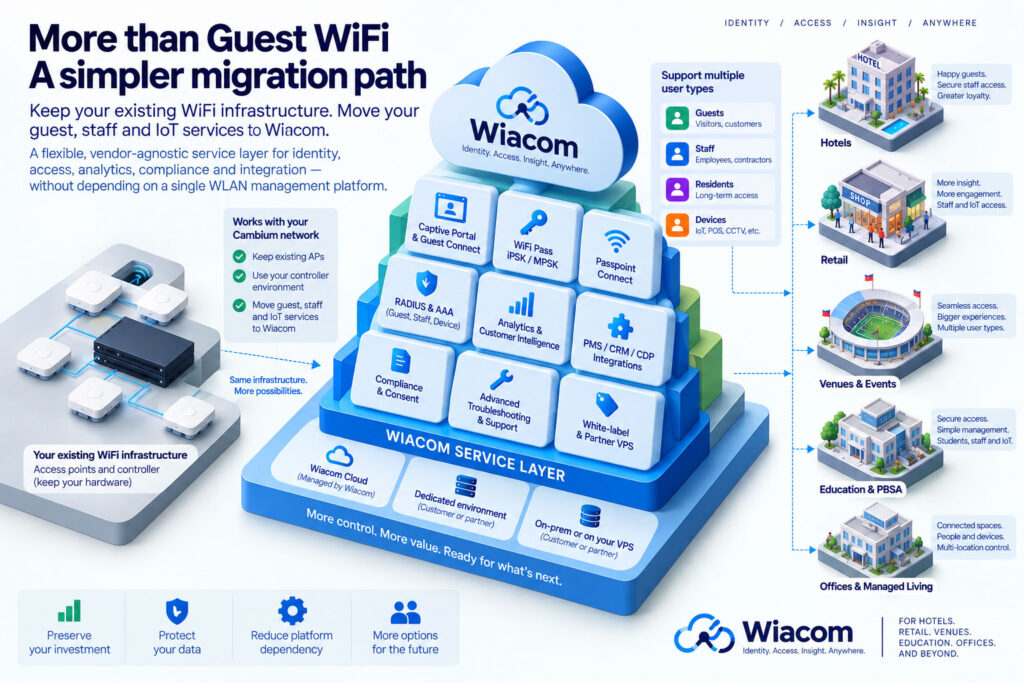
Wiacom can provide an independent identity, onboarding, access and customer-intelligence layer while allowing organisations to retain compatible existing WiFi infrastructure where appropriate.
Keep the WiFi. Move the service layer.
Wiacom can sit above the existing WLAN infrastructure and support:
- guest, staff and device onboarding;
- Captive Portal and Guest Connect;
- personal WiFi credentials through WiFi Pass;
- Passpoint Connect;
- RADIUS / AAA;
- guest and customer analytics;
- consent and compliance workflows;
- email and SMS communications;
- PMS, CRM/CDP, loyalty and external-system integrations;
- advanced troubleshooting;
- white-label and multi-tenant deployments;
- cloud, dedicated, on-premises or partner/customer VPS hosting.
This allows the underlying WiFi infrastructure to evolve independently from the identity and service layer.
Cambium to Wiacom: feature mapping
| Cambium / cnMaestro | Wiacom alternative | Migration approach |
|---|---|---|
| EasyPass Captive Portal | Wiacom Captive Portal | Branded onboarding, verification, consent and access |
| Self Registration | Portal / Guest Connect | On-site or off-site onboarding by URL/QR |
| Google / Microsoft / Social login | OAuth / OIDC integrations | Reuse existing identity providers |
| ePSK | WiFi Pass | Personal iPSK/MPSK/DPSK credentials where supported |
| UPSK | Migration to supported personal credential mechanisms | UPSK is proprietary; workflows can move toward supported iPSK/MPSK/DPSK models |
| Personal WiFi | Wiacom Horizon | Personal WiFi / SSID onboarding |
| Guest / Staff / Device access | Wiacom identity-based access | Different onboarding and policies by user type |
| Google / Azure login | Wiacom Social OAuth / OIDC integrations | Can integrate with Google, Microsoft and existing customer identity providers. |
| Passpoint / Hotspot 2.0 | Passpoint Connect | Secure automatic reconnection |
| Analytics | Wiacom WiFi Analytics | Registrations, visits, dwell/presence, engagement and multi-site reporting |
| Customer integrations | PMS / CRM / CDP / Loyalty / APIs | Connect WiFi identity and access to business systems |
| Email / SMS workflows | Wiacom Communication Services | Transactional email, verification, OTP, SMS and campaign workflows |
| Consent management | Wiacom Consent + UserPortal | Preferences, opt-out and CRM/CDP synchronisation |
| Custom workflows | Wiacom APIs & custom integrations | PMS, CRM/CDP, loyalty, identity, controller and business-system integrations. |
| Cloud service | Wiacom Cloud | Managed by Wiacom |
| Customer-controlled hosting | On-premises / customer VPS | Customer-controlled deployment |
| Partner-controlled hosting | White-label on partner VPS | MSP/integrator controls branding and hosting |
| Troubleshooting | Advanced Wiacom support | Portal, RADIUS, credentials, sessions and controller integrations |
Guest, staff and device access
Wiacom is not limited to public guest WiFi.
Different identity and access workflows can be used for:
- guests and visitors;
- hotel guests and residents;
- staff and contractors;
- students;
- long-term users;
- IoT and dedicated devices.
Each group can use a different onboarding method, credential type, validity period and network policy.
Email and SMS communication services
Wiacom can also provide the communication layer around onboarding and identity.
Available workflows can include:
- registration and confirmation emails;
- OTP delivery;
- transactional SMS;
- SMS gateway integration;
- access or credential notifications;
- pre-arrival communications;
- campaign email;
- campaign SMS;
- segmented communications based on eligible audiences.
This means organisations and partners do not necessarily need to build a separate communication workflow around the WiFi platform.
Custom integrations for larger deployments
Larger WiFi environments rarely fit a single standard workflow.
Wiacom can integrate with:
- PMS and reservation systems;
- CRM and CDP platforms;
- loyalty applications;
- customer identity providers;
- external portals and applications;
- APIs;
- operational systems;
- custom partner platforms.
Custom integrations can be used to automate onboarding, credential creation, expiry, identity synchronisation, customer-data flows and operational processes as deployments scale.
For MSPs and integrators, this makes it possible to support different customer requirements while keeping a common Wiacom service layer underneath.
Preserve analytics, consent and customer data
A platform migration does not need to mean losing the intelligence around WiFi.
Wiacom can maintain or extend:
- verified profiles;
- registrations;
- repeat visits;
- dwell and presence trends;
- campaign engagement;
- consented first-party data;
- multi-location analytics;
- CRM/CDP synchronisation;
- preference and consent updates.
Advanced troubleshooting
Guest and staff WiFi issues can originate from several layers:
Device → WLAN → controller → portal → RADIUS → identity → access policy
Wiacom can help investigate portal, authentication, RADIUS, credential, Passpoint and controller-integration issues and determine whether the problem sits in the Wiacom layer, WLAN platform or customer network.
Cloud, on-premises or white-label
Wiacom can be delivered as:
Wiacom Cloud — managed by Wiacom.
Dedicated / on-premises — for customers requiring greater control.
Partner or customer VPS — including white-label deployments operated on infrastructure controlled by the MSP, integrator or customer.
This gives partners more flexibility and avoids replacing one platform dependency with another.
Free migration trial
Cambium customers and partners can request a free Wiacom trial to validate the required workflows before committing to a broader migration.
Where technically possible, existing hardware can remain in place while the service layer is tested.
The objective is straightforward:
Keep the infrastructure where it makes sense. Preserve guest and staff access, identity, communications, analytics and integrations. Gain more control over the service layer.
Wiacom can help Cambium customers, MSPs and partners assess existing EasyPass, ePSK/UPSK, RADIUS, captive portal, analytics, communication and integration workflows and identify a practical migration path.
Request a Migration Assessment → Explore Wiacom for MSPs → Explore Wiacom features (tech side) →
