
COMING SOON — EARLY ACCESS PROGRAMME
Hybrid WiFi Identity & Access Management
Wiacom Edge
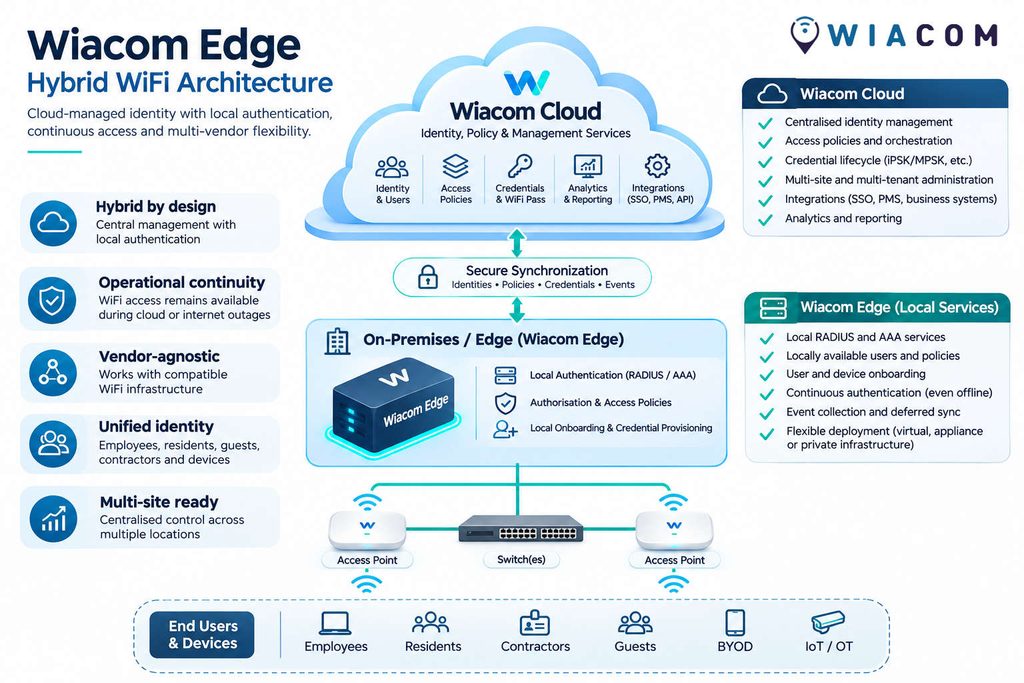
Wiacom Edge is a hybrid WiFi identity and access management solution designed to combine centralised cloud management with distributed, locally available authentication, onboarding and identity services.
Designed for enterprises, MSPs, ISPs and multi-site organisations, Wiacom Edge extends the capabilities of existing WiFi infrastructure, reduces external cloud dependencies and simplifies identity management across different WiFi vendors.
Manage identities, credentials and access policies centrally while bringing essential network-access services closer to the network.
Cloud-managed. Locally resilient. Vendor-agnostic.
Should WiFi Authentication Depend Entirely on the Cloud?
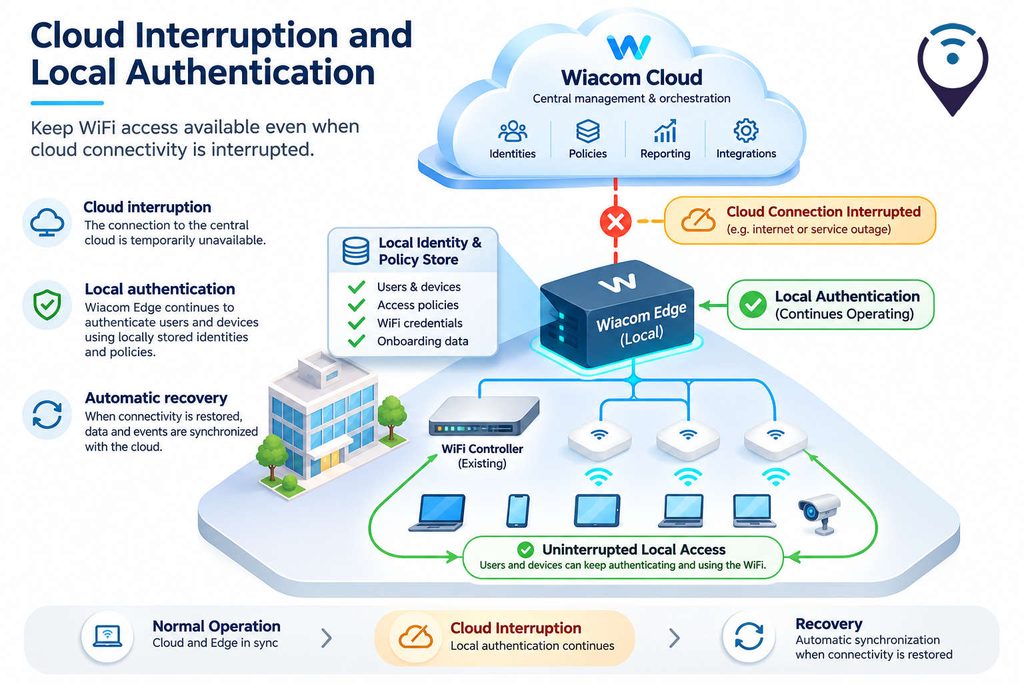
Cloud-managed WiFi has simplified the deployment and operation of wireless networks. However, depending on the architecture, authentication, credential provisioning and user onboarding may remain dependent on remote cloud services.
When internet connectivity or an external cloud service becomes unavailable, organisations may experience difficulties with:
- authentication of new or reconnecting users;
- device onboarding;
- individual WiFi credential provisioning;
- access-policy enforcement;
- resident, employee or contractor access;
- visibility into local authentication activity.
Wiacom Edge is designed to reduce these dependencies by bringing supported authentication and identity services into customer-controlled infrastructure.
Centralised management does not have to mean centralised authentication.
Centralised Intelligence. Distributed Authentication.
Wiacom Edge combines two complementary infrastructure layers, separating centralised management from the local execution of supported identity and access services.
Wiacom Cloud — Central Management
- Centralised identity management
- Multi-tenant and multi-site administration
- Access-policy management
- Credential lifecycle management
- Identity provider and business integrations
- Analytics, monitoring and reporting
- Edge configuration and orchestration
Wiacom Edge — Local Services
- Local RADIUS and AAA services
- Locally available authentication data
- Local access-policy execution
- Supported local onboarding workflows
- Local authentication event collection
- Secure cloud-to-edge synchronisation
- Deferred synchronisation after connectivity interruptions
One central management platform. Multiple distributed Edge instances.
WiFi Authentication Designed for Operational Continuity
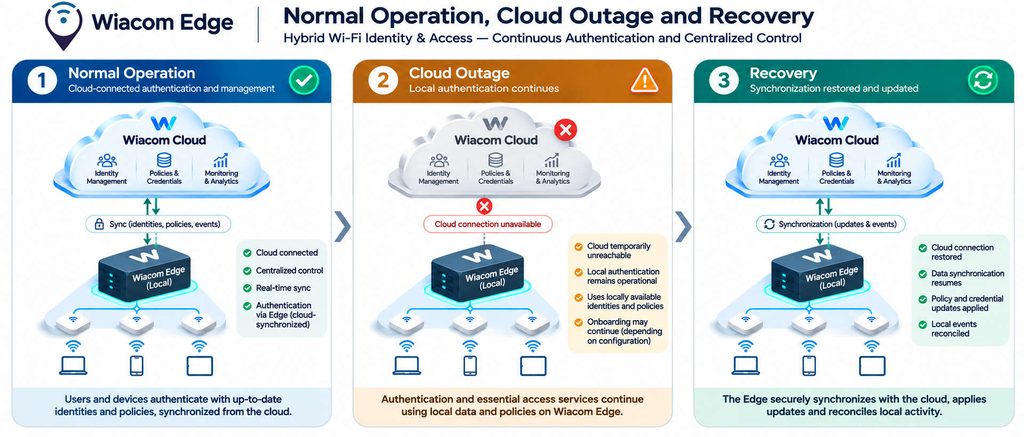
Wiacom Edge is designed to maintain supported network-authentication services even when connectivity to the central Wiacom platform is temporarily unavailable.
During Normal Operation
Identities, eligible authentication data and access policies are synchronised between Wiacom Cloud and the distributed Edge infrastructure.
During Cloud Connectivity Interruptions
Supported local authentication requests can be processed using locally available credentials and policies. Eligible onboarding workflows can continue where the necessary infrastructure and services remain locally accessible.
When Connectivity Is Restored
Edge services can resume synchronisation with the central platform, reconcile eligible local activity and receive updated access policies.
Operational resilience without automatically bypassing authentication or access controls.
Local availability depends on the authentication method, locally available data, credential validity, security policies and underlying WiFi infrastructure.
One Identity Layer Across Multiple WiFi Vendors
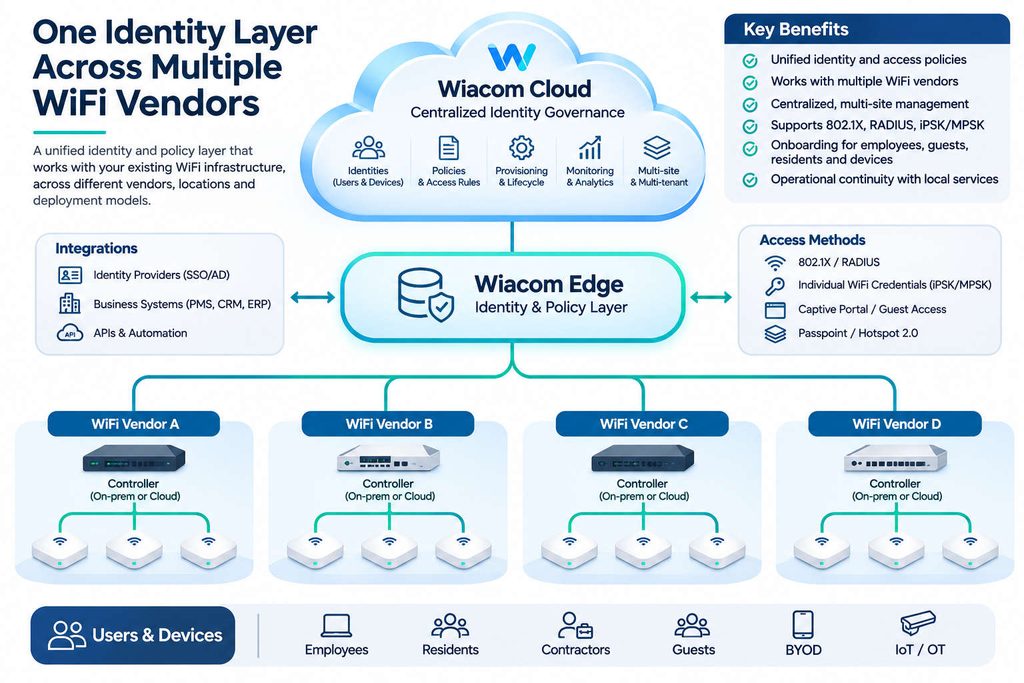
Enterprises, managed WiFi providers and multi-site organisations increasingly operate infrastructure from different WiFi manufacturers.
Different access points, controllers and cloud management platforms do not necessarily need to result in separate identity and access-management environments.
Wiacom Edge is designed to provide a common identity layer across compatible wireless infrastructure, helping organisations to:
- reduce dependence on proprietary identity services;
- maintain consistent onboarding workflows;
- manage individual credentials centrally;
- preserve identity continuity during WiFi migrations;
- operate mixed-vendor environments;
- extend existing network investments.
Wiacom Edge complements existing network infrastructure rather than replacing access points, controllers, gateways or vendor management platforms.
WiFi vendors may change. Your identity infrastructure should not have to.
More Than a Local RADIUS Server
Traditional RADIUS services primarily address network authentication, authorisation and accounting. Wiacom Edge is designed to extend these capabilities by connecting distributed authentication services with the broader Wiacom identity, onboarding and access-management ecosystem.
RADIUS and Enterprise WiFi Authentication
Local authentication and authorisation for compatible enterprise WiFi environments, including supported 802.1X and RADIUS-based authentication methods.
WiFi Pass — Individual WiFi Credentials
Personal WiFi credentials using compatible iPSK, MPSK, PPSK or DPSK technologies. Connect individual credentials with user identity, access policies, expiration and credential lifecycle management.
Guest Connect — Self-Service Onboarding
Branded user and device onboarding through web links, QR codes and supported business workflows. Extend onboarding into locally accessible environments where the required services are available.
Captive Portal
Controlled visitor and guest registration, identity verification, consent management and network-access authorisation.
Passpoint Connect
Secure profile-based WiFi onboarding and automatic connectivity across compatible Passpoint and Hotspot 2.0 environments.
Enterprise Identity and External Integrations
Integration opportunities with enterprise identity providers, directories, SSO, property management systems, resident management platforms and other business applications.
External identity-provider authentication may still require connectivity to the relevant service. Locally available authentication depends on the configured method and available credentials.
Individual access methods and their local availability depend on the WiFi infrastructure, integration method and deployment configuration.
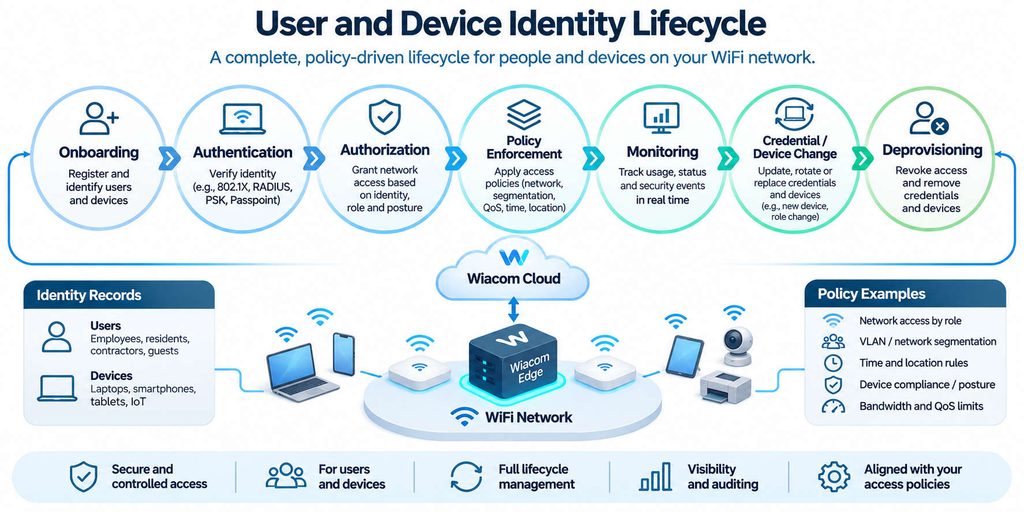
Manage the Complete WiFi Access Lifecycle
Network access should be associated with an identifiable user, device or business relationship rather than being limited to unmanaged shared passwords.
The Wiacom Edge architecture is designed to connect network authentication with the wider identity lifecycle:
- User or device registration
- Identity verification
- Credential provisioning
- Access-policy assignment
- Network authentication
- Credential renewal and rotation
- Access expiration and revocation
- Authentication activity and auditing
This approach connects network access with employee, resident, guest, contractor and device lifecycles.
Register → Identify → Provision → Authenticate → Manage → Revoke
Flexible Deployment Architecture
Wiacom Edge is being designed to accommodate different infrastructure ownership, security, availability and operational requirements.
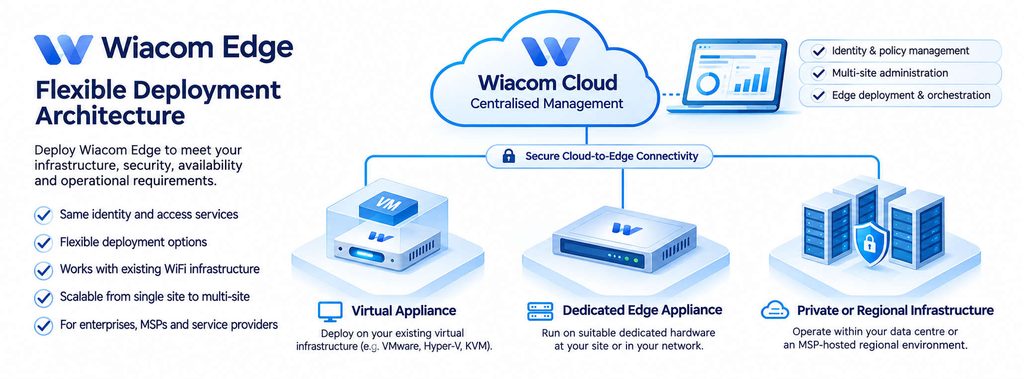
Virtual Appliance
Deploy local authentication and identity services within existing customer or partner virtual infrastructure.
Dedicated Edge Appliance
Run Edge services on suitable dedicated local hardware within the customer network.
Private or Regional Infrastructure
Operate Edge services within customer-controlled data centres or MSP-hosted regional infrastructure.
Deployment architectures can range from a single local Edge instance to distributed authentication services across an entire enterprise or managed WiFi portfolio. Regional deployments depend on connectivity between the served locations and regional infrastructure.
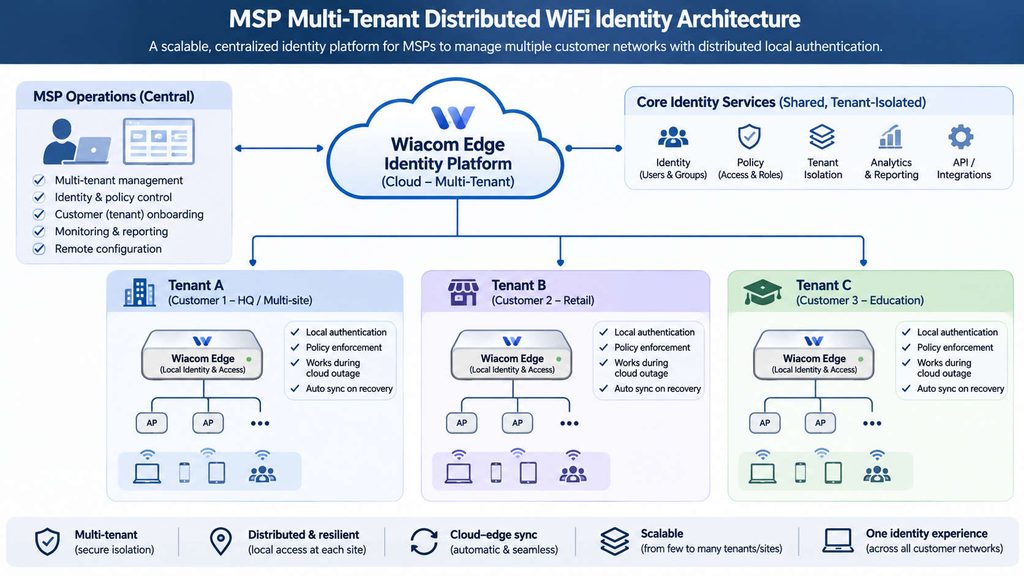
Built for MSPs, ISPs and Network Integrators
Managed WiFi providers often support multiple customers, different WiFi manufacturers and diverse access-management requirements.
Wiacom Edge is designed to provide a common foundation for delivering managed identity and network-access services independently of a single infrastructure vendor.
Potential managed service opportunities include:
- Managed RADIUS and AAA services
- WiFi identity as a managed service
- Individual WiFi credential management
- Employee, guest and resident onboarding
- Distributed authentication infrastructure
- Mixed-vendor access management
- Customer-specific access policies
- Centralised monitoring and troubleshooting
- Multi-tenant service administration
Service providers can explore recurring revenue opportunities around identity and access management while continuing to offer the WiFi infrastructure best suited to each customer.
One managed identity platform. Multiple customers. Multiple locations. Multiple WiFi vendors.
Explore Wiacom solutions for MSPs and managed WiFi providers.
Hybrid WiFi Identity Across Different Industries
Enterprise & Distributed Offices
Consistent employee, contractor, visitor and device access across distributed locations and mixed-vendor WiFi infrastructure.
Healthcare
Explore resilient authentication for supported staff, visitor and device connectivity workflows where network-access availability matters.
MDU, PBSA & Managed Living
Connect resident identity, personal WiFi credentials, device onboarding and credential expiration with the resident lifecycle across property portfolios.
Hospitality
Combine guest identity, PMS-driven onboarding, individual WiFi credentials and locally available authentication services.
Education & Campus
Student, staff, visitor and personal-device onboarding through a common identity and authentication architecture.
Industrial & Logistics
Reduce external authentication dependencies in supported operational environments where local network services are important.
Security, Data Control and Operational Resilience
Wiacom Edge is being designed around a distributed security architecture intended to maintain centralised control while allowing selected services to operate within customer-controlled infrastructure.
Key architectural objectives include:
- Secure communication between cloud and Edge services
- Controlled local availability of authentication data
- Customer and tenant separation
- Centralised access-policy administration
- Credential validity and lifecycle controls
- Authentication event visibility and auditing
- Controlled synchronisation and recovery
- Flexible infrastructure ownership
Local authentication is intended to follow the applicable security and credential-validity policies rather than automatically granting network access when an external service is unavailable.
Specific data residency, retention, high-availability and security requirements will be evaluated according to the deployment architecture.
Wiacom Edge — Frequently Asked Questions
What is Wiacom Edge?
Wiacom Edge is an upcoming hybrid WiFi identity and access management solution combining centralised cloud management with distributed local authentication and identity services.
Can WiFi authentication work without internet connectivity?
Supported local authentication workflows are intended to remain available when connectivity to the central cloud platform is interrupted, provided the necessary local infrastructure, credentials and access policies remain available.
Can new users be onboarded during a cloud outage?
Local onboarding is an architectural objective of Wiacom Edge. Availability depends on the selected onboarding method, identity-verification requirements and local credential-provisioning capabilities of the network infrastructure.
Does Wiacom Edge replace the WiFi controller?
No. Wiacom Edge is designed to complement compatible WiFi controllers, access points, gateways and cloud-managed network platforms by providing an additional identity and access-management layer.
Is Wiacom Edge vendor-agnostic?
Wiacom Edge is designed around standards-based authentication and compatible vendor-specific integrations. Feature availability will depend on the WiFi infrastructure, authentication method and integration capabilities.
Is Wiacom Edge a local RADIUS server?
Local RADIUS and AAA services are part of the planned architecture. Wiacom Edge also aims to connect these services with identity management, user onboarding, credential lifecycle management and centralised orchestration.
Can Wiacom Edge support personal WiFi passwords?
Individual WiFi credential management is part of the intended Wiacom Edge ecosystem. Supported iPSK, MPSK, PPSK or DPSK workflows will depend on the capabilities and integration methods of the underlying WiFi infrastructure.
Can Wiacom Edge integrate with enterprise identity providers?
External identity-provider and directory integrations are part of the intended architecture. Authentication methods requiring direct communication with an external identity provider may remain dependent on connectivity to that service.
Can Wiacom Edge be deployed on-premises?
On-premises virtual appliances, dedicated local hardware and private infrastructure deployments are among the planned deployment models.
Can MSPs manage multiple customers using Wiacom Edge?
Multi-tenant administration, customer separation and distributed Edge deployments are central objectives of the Wiacom Edge architecture.
Does Wiacom Edge replace Wiacom Cloud?
No. Wiacom Edge extends the Wiacom Cloud platform with distributed local services, allowing centralised management and locally available authentication to coexist.
Is Wiacom Edge available now?
Wiacom Edge is currently in development. Organisations and technology partners can register their interest to discuss requirements and explore early-access opportunities.
Your WiFi Infrastructure May Change. Your Identity Infrastructure Should Not Have To.
Explore a hybrid approach to network authentication, identity management and onboarding across compatible WiFi environments.
Wiacom Edge — Cloud-managed. Locally resilient. Vendor-agnostic.
WiFi Identity, Access, Engagement and Analytics for Marketing, IT & Operations Teams

US, UK, EU: +40 721 260 892
info@wiacom.ai
© 2026 Wiacom
All rights reserved

